AI for Sustainability: 2025 Year in Review

Articles featured: The great AI hype correction of 2025, The 2025 AI Index Report, Top 5 AI stories of 2025: Agents & automation, Genesis & GPUs, The Architects of AI are TIME's 2025 Person of the Year
It’s the end of the year, which can only mean three things:
- Holiday season is officially ON (happy holidays!)
- The pre-Christmas work scramble is in full swing
- The internet is drowning in “end-of-year” round-ups
Points one and two mean that actually reading all those reports is… optimistic. Especially when half of them aren’t even in your wheelhouse.
Good news: you can skip the homework.
We’ve done the heavy lifting and cut through the noise to tell you what’s happening in tech and why it matters for climate.
It’s been 3 years since ChatGPT crash-landed into our lives on 30 November 2022 and rewrote the rules of how we work. Since then, everything has shifted - for sustainability professionals and pretty much everyone else.
These three year-end reports unpack what that transformation looks like in 2025, from the 30,000-foot view down to the nitty-gritty.
For each one, we pull out the can’t-miss insights and translate them into sustainability relevance- so you stay smart, informed, and report-free.

MIT: The great AI hype correction of 2025
The great AI hype correction of 2025
MIT cuts through both the over-hype and the growing disillusionment with four key observations about AI's limitations in its current state:
- LLMs are not everything
- AI is not a quick fix to all your problems
- Are we in a bubble? (If so, what kind of bubble?)
- ChatGPT was not the beginning, and it won't be the end
For sustainability professionals: ChatGPT and similar tools have proven valuable as support, not replacements, for your work. That said, it’s natural to feel apprehensive about the future of work and question the quality of AI tools.
If you’re not directly in AI, the rapid pace of model improvements, widespread adoption, and constant commentary over the past three years can be overwhelming. MIT breaks down the year’s trends in a clear, pragmatic way, easing short-term concerns while giving a sense of where the technology is headed.

Stanford: The 2025 AI Index Report
This comprehensive report analyses AI across all aspects, from healthcare and business adoption to safety, science, education, and beyond.
In the 457-page report (neatly summed up into 12 takeaways that are worth reading!) there were two charts that stood out as particularly relevant for sustainability professionals:
- The carbon emissions from training frontier AI models have steadily increased over time
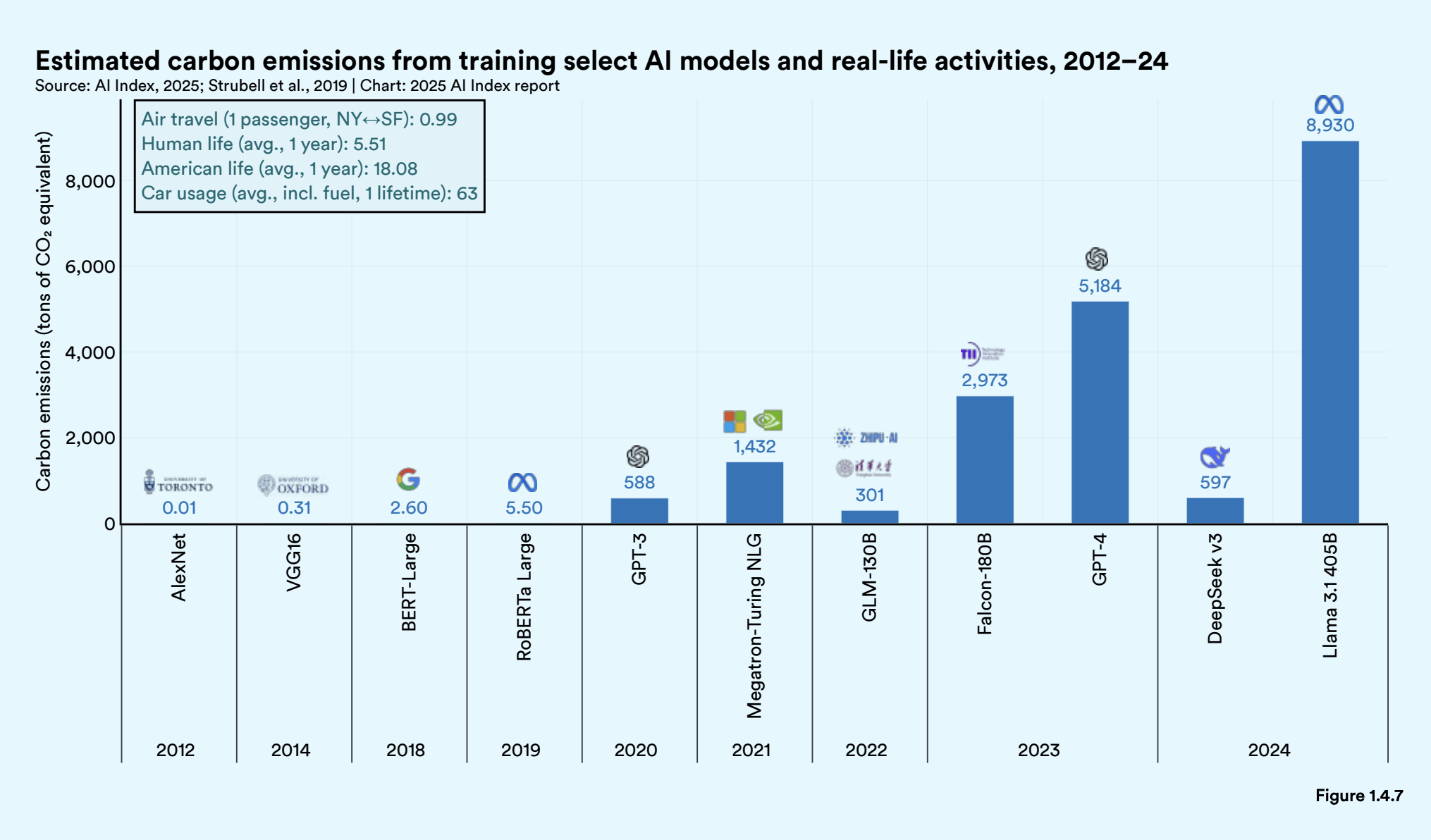
- Share of respondents who say their organisation uses AI in at least one function has jumped from 55% to 78% in 2024
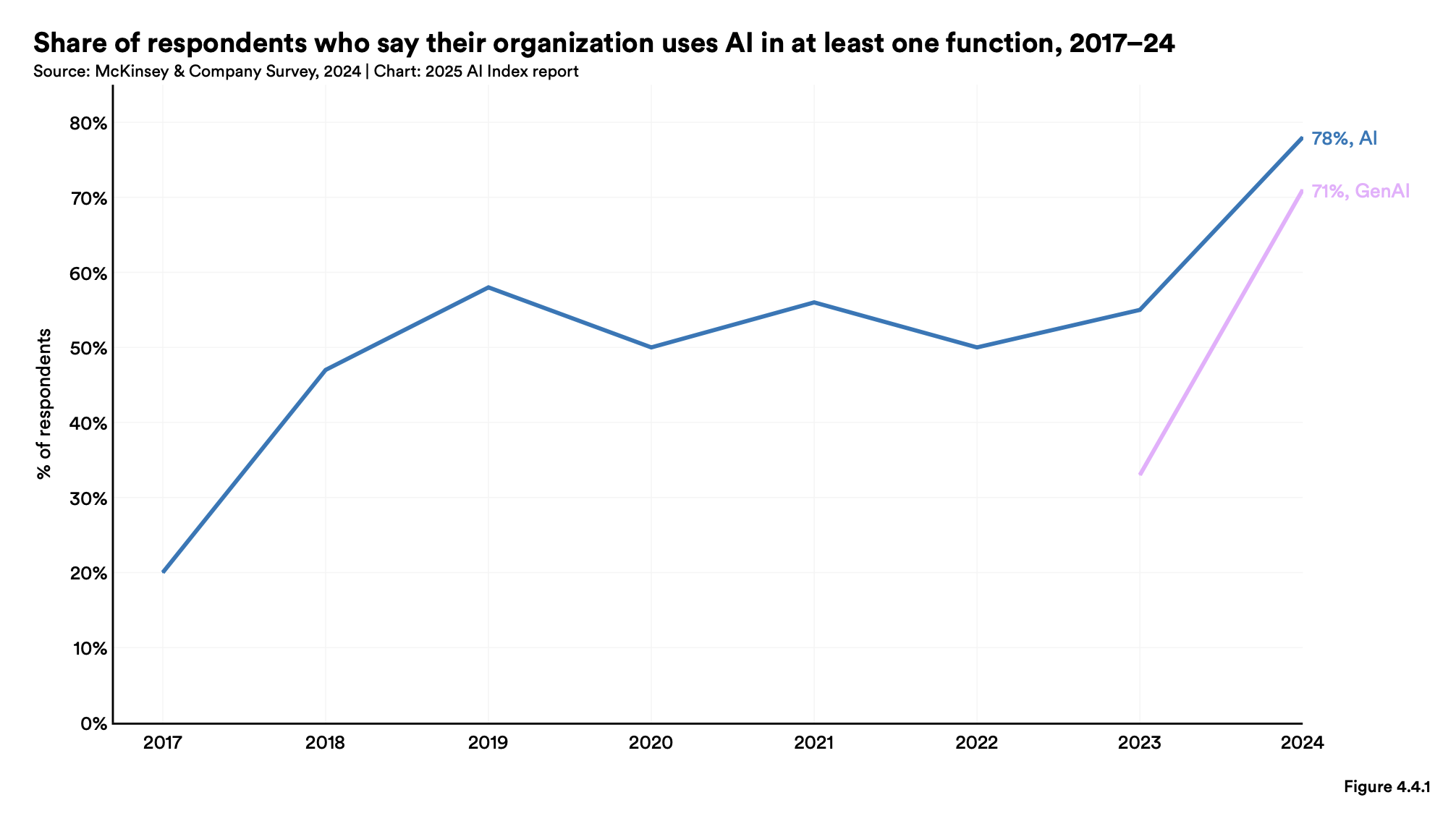
For sustainability professionals: While you don't need to worry about your own personal AI usage's negligible impact, the scaled impacts of AI at the economy level are having a real effect on energy use. As adoption accelerates, understanding both the opportunities and the environmental implications becomes increasingly important for sustainability strategy.

SDX Central: 5 AI Stories of 2025
Top 5 AI stories of 2025: Agents & automation, Genesis & GPUs
This round-up covers specific news stories about AI from the year: from the US Government's Genesis Mission to DeepSeek's challenge to Western tech giants.
For sustainability professionals: Two stories stand out for climate implications:
First, the DeepSeek debacle demonstrated that China built frontier AI models for a fraction of the cost and with far less powerful hardware than Western competitors. For the planet, it suggests that AI advancement doesn't necessarily require ever-increasing energy consumption.
Second, the reality check on agentic AI and automation is instructive. Major outages at Cloudflare and AWS were caused by automation tools that weren't quite ready for primetime. The hype around AI agents is outpacing the actual capabilities and sustainability teams evaluating AI tools should retain a healthy scepticism.

Honourable mention: Time's 2025 Person of the Year: The Architects of AI
The Architects of AI are TIME's 2025 Person of the Year
Time named not one person, but a collective: the researchers, engineers, and entrepreneurs building the foundation of AI. The feature profiles key figures like Sam Altman, Demis Hassabis, Jensen Huang, and Dario Amodei.
For sustainability professionals: It's a useful reminder that AI isn't an abstract force and it's being shaped by specific people with specific priorities. Understanding who's building these tools and what they value helps us better evaluate which AI developments will genuinely serve sustainability goals.
In 2026, AI will continue to transform how we work, but as 2025 has shown us, AI is not magic. Sustainability professionals with real expertise are still needed. As AI use becomes ubiquitous in the workplace, strong awareness of AI development and AI limitations is no longer optional.
Happy holidays and see you in the new year!
Natasha and the ClimateAligned team
Explore our products:
app.climatealigned.co - Access our labelled bond data service with insights on 30,000+ bonds. Check out a free sample!
brief.green - Run AI-powered ESG assessments on-demand. Sign up for free!
Want to learn more about what we do? Visit climatealigned.co
Want to automate a workflow you find annoying and slow? We'd love to hear more! Fill out our Typeform