From Research to Report: Your AI Toolkit for Sustainability Analysis

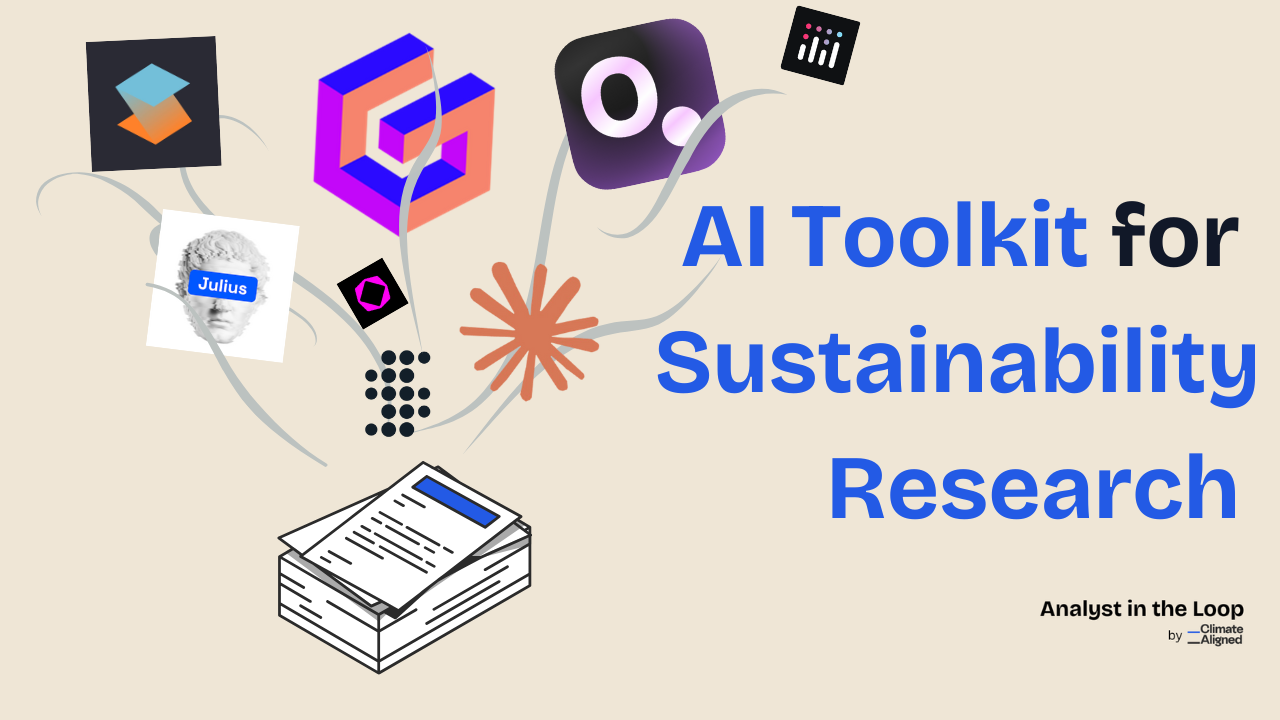
AI has made high-quality sustainability research easier than ever—and in the quest to decarbonise our economy, it's never been more important.
Strong research can serve many purposes, from building your company's brand to identifying market risks and opportunities.
While AI simplifies the research process, it has serious limitations. Different tools excel at different stages. Below, we break down each part of the research workflow and recommend tools to help you create high-quality outputs, whatever questions you're trying to answer.
This is not sponsored, and these are our genuine recommendations.
1. Literature Review
The foundation of any research project starts with understanding what's already been published—these AI-powered databases offer a more powerful alternative to Google Scholar.
- Scispace: Platform that searches and analyses over 280 million papers, with features for extracting data, generating summaries, and asking questions directly to PDFs.
- Elicit: Automates systematic literature reviews by searching over 125 million papers, accurately extracting key data and generating comprehensive research reports.
- Undermind: Conducts deep, iterative searches that mimic expert discovery processes, using citation trails and adaptive learning to surface highly relevant papers others miss.
For deeper technical comparisons, this analysis provides useful context.
2. Workspace Management
These AI-powered workspaces help keep your sources, notes, and drafts organised throughout your research process.
- Otio: Purpose-built workspace for researchers that collects sources from any format (PDFs, videos, websites), generates AI notes, and helps you draft outputs grounded in your collected materials.
- Notion AI: Intelligent, generalist workspace that combines note-taking, databases, and AI-assisted writing to help you organise and synthesise research across interconnected pages.
- Claude Projects: Dedicated workspace within Claude that maintains context and build knowledge bases across long research conversations.
3. Data Analysis and Visualisation
The following tools help you transform raw data into meaningful insights. Conduct statistical analyses, create charts without coding expertise.
- Julius AI: Conversational data analyst that turns spreadsheets into visualisations through natural language queries, handling everything from basic statistics to advanced modelling.
- Sisense: Business intelligence platform that combines data from multiple sources to create interactive dashboards and uncover hidden patterns in your datasets.
- Plotly: Open-source graphing library that creates publication-quality interactive charts and dashboards, with support for Python, R, and JavaScript.
4. Presentation Tools
The following AI tools transform your ideas into professional decks without design skills.
- Gamma: AI presentation maker that generates complete slide decks from prompts, featuring modern, scrollable designs without formatting headaches.
- Tome: Storytelling platform that uses AI to create compelling presentations with intelligent layouts, automatically sourcing relevant images and structuring your narrative flow
- Canva AI: Our well-loved Canva has AI-powered presentation features that instantly generate on-brand slides, suggests layouts, and provides access to millions of stock assets.
5. Citation Verification
The following tools give you an upper hand with citations and ensure the reliability of your sources.
- Scite: Shows how research papers cite each other with smart citations that classify whether studies support, contradict, or mention claims, plus flags retracted papers.
- Consensus: AI-powered search engine that finds scientific papers and synthesises findings across studies, showing you whether the research consensus supports specific claims.
- Sourcely: Academic citation finder that discovers credible sources for your research papers and automatically generates citations in any format.
Bonus from our team:
6. Bulk document processing
Try for freeWhen your research requires analysing the same questions or frameworks across dozens or hundreds of documents, manual review becomes impractical. Shameless plug: our tool automates systematic analysis at scale.
- Brief.green: Automates research questions and framework analysis across large document sets for regulatory and ESG research, with full source transparency.
Whether you're analysing carbon disclosures, mapping supply chain risks, or building the business case for net zero, the right tools can save you hours each week.
Give one of these tools a try this week and let us know which sustainability challenge it helped you tackle. It helps us know a little bit more about what you're looking for. 🔍
See you next Wednesday!
Natasha and the ClimateAligned team
P.S. Happy Thanksgiving week to my fellow Americans! 🦃🍁🍽️
Disclaimer: The products mentioned in this newsletter are ones we personally use and genuinely recommend. We have not been paid, sponsored, or otherwise compensated by any brand or company to endorse these products. All opinions expressed are our own.
Explore our products:
app.climatealigned.co - Access our labelled bond data service with insights on 30,000+ bonds. Check out a free sample!
brief.green - Run AI-powered ESG assessments on-demand. Sign up for free!
Want to learn more about what we do? Visit climatealigned.co
Want to automate a workflow you find annoying and slow? We'd love to hear more! Fill out our Typeform